Existing Job Skills Expected to Change by 2030
Workers' core skill sets are projected to transform significantly by 2030 as AI, automation, and software-defined workflows redefine engineering expectations.
Bharat AI Forge — Building India's Next Generation of AI Engineers.
An industry-integrated AI engineering program that transforms classroom knowledge into hands-on expertise in Machine Learning, Generative AI, Agentic AI, cloud deployment, and real-world application development.
* Proposed program architecture specifications designed for engineering students and partner colleges across India.
Almost every graduate can talk about conversational AI tools. Employers now look for engineers who can architect, evaluate, deploy, and defend complete AI systems in production.
Workers' core skill sets are projected to transform significantly by 2030 as AI, automation, and software-defined workflows redefine engineering expectations.
Projected gross job creation globally by 2030 driven by macroeconomic, technological, and green transitions across the broader global workforce (not all 170 million roles are AI-specific).
Nearly two-thirds of surveyed employers cite skills gaps in the workforce as the primary obstacle to business transformation through 2030.
Over 90% use AI tools, yet only 23% are AI-native builders who can design, integrate, and ship production systems.
Source: NASSCOM, reported July 2026AI hiring in India's IT sector rose 16% year-on-year in June 2026, even as overall IT job listings fell 3% in the same period.
Source: Naukri JobSpeak, June 2026Employment of the youngest general software developers has faced pressure since 2024 even as specialized AI engineering hiring grows.
Source: Stanford AI Index 2026India trains one of the largest pools of young engineers in the world (~850,000 engineering bachelor's graduates annually). However, rapid advances in Generative and Agentic AI move faster than university curriculum revision cycles.
Comparative view of projected enterprise demand and available AI/GenAI talent in India for 2026.
Demand is projected at ~1.5x supply (2.3M openings vs. 1.2M talent). Source: Bain & Company, Mar 2025.
Projected AI professional shortage in India by 2027. Source: NASSCOM (reported in Programme Booklet).
India graduates ~850K engineering B.Tech/B.E. students/yr (vs. ~1.5M in China, ~140K in US). Source: Goldsea, Mar 2026.
India ranks 5th for Future of Work readiness but 18th for Skills Alignment. Source: QS (Sep 2026).
Students need more applied engineering exposure.
AI tooling evolves every few months—faster than academic syllabus cycles. Complementing university theory with hands-on system architecture bridges this gap without disrupting degree studies.
Graduates need experience beyond notebook demonstrations.
Engineering teams need developers who can take models out of local notebooks and build FastAPI services, RAG pipelines, multi-step agents, evaluation harnesses, and Docker containers.
Students need credible evidence of technical competence.
In modern technical hiring, verifiable proof of work—shipped GitHub repositories, open-source contributions, evaluation reports, and live demos—sets candidates apart across every tier of college.
Bharat AI Forge unites timeless conceptual foundations, rapidly evolving GenAI and Agentic tools, production cloud deployment, and career credibility into one cohesive engineering program.
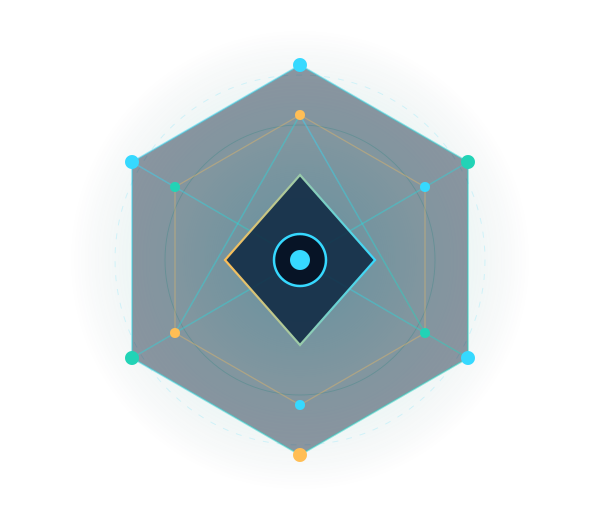
Select any of the 6 connected pillars below to inspect its technical stack and outcomes:
"Learn. Experiment. Build. Deploy. Showcase."
| Engineering Area | Example Technologies Students Work With | What Students Build |
|---|---|---|
| Prompt & Context Engineering | Leading chat and reasoning models (Gemini, Claude, ChatGPT) | Reliable prompts, structured outputs, and reusable prompt libraries |
| LLM APIs & Tool Use | Model APIs with structured function calling | An application that invokes external tools, APIs, and services |
| Retrieval-Augmented Generation (RAG) | Dense embeddings, chunking, vector databases & rerankers | A grounded question-answering assistant over custom documents |
| AI Agents & Orchestration | LangGraph, Google ADK, Model Context Protocol (MCP) | A multi-step agent that plans, uses tools, and verifies its work |
| AI-Assisted Software Engineering | Antigravity, Claude Code, GitHub Copilot | Features, bug fixes, and unit tests written with an AI pair-programmer and critically reviewed |
| Evaluation & Guardrails | Golden test sets, automated evaluation, safety & bias filters | An evaluation report measuring accuracy, hallucination, and bias |
| Cloud Deployment & MLOps | FastAPI, Docker containers, Google Cloud & AWS deployment tiers | A live, containerized, shareable cloud demonstration of their project |
Explore all seven integrated modules totaling 160 learning hours—including 12 dedicated career and open-source readiness hours so that technical mastery translates directly into verifiable employability.
Students learn by shipping, not just watching. Every week follows a disciplined engineering cadence that turns conceptual knowledge into deployed software.
Understand the concept.
Focused concept videos, intuition-first reading notes, and quick comprehension quizzes on the learning portal.
Practice with models, tools, and datasets.
Guided coding laboratories with real datasets, prompt parameters, embeddings, and red-team safety checks.
Develop a working AI application.
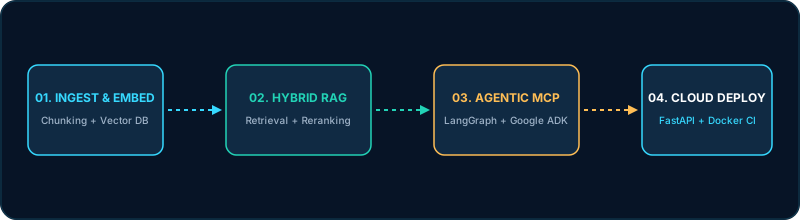
Assemble RAG pipelines, LangGraph / Google ADK agents, MCP tool servers, and FastAPI backends with mentor code review.
Make your solution accessible and demonstrable.
Containerize with Docker, deploy to cloud, publish an architecture README on GitHub, and present live demos.
Campus & portal labs covering syllabus RAG, workflow agents, AI pair-programming, and accuracy audits.
Practitioner feedback on architecture exercises, evaluation test sets, and production cloud deployments.
from fastapi import FastAPI
from bharatai_forge.rag import HybridRetriever, CrossEncoderReranker
from bharatai_forge.agents import AgentOrchestrator, GuardrailEvaluator
app = FastAPI(title="BharatAIForge-Production-Service")
retriever = HybridRetriever(collection="campus_knowledge_v2", top_k=8)
reranker = CrossEncoderReranker(top_n=3)
guardrails = GuardrailEvaluator(min_faithfulness=0.92)
@app.post("/v1/agent/query")
async def execute_grounded_agent(query: str):
docs = reranker.rank(query, await retriever.search(query))
response = await AgentOrchestrator.run_with_mcp(query=query, context=docs)
audit = guardrails.verify(query=query, context=docs, answer=response)
return {"answer": response, "citations": docs.sources, "audit": audit}
Focused concept lessons, cheat sheets, and reading material optimized for laptops and phones.
Quick concept checks after each lesson plus module assessments that track mastery.
Guided labs using modern LLMs, LangGraph, Google ADK, Claude Code, and Antigravity.
Batch progress, lab attendance, assessment scores, and a public student GitHub project gallery.
Explore sample industry and India-focused project tracks designed for student engineering pods. Each track requires system architecture, quantitative evaluation, cloud deployment, and public GitHub documentation.
For an early-career engineer, GitHub is your living technical portfolio. We guide every participant in structuring pinned repositories, writing architecture READMEs, and contributing to real open-source projects.
Hybrid vector + keyword clinical RAG with cross-encoder reranking & hallucination audit.
● Python • FastAPI • Docker • MIT LicensePlanner-Researcher-Critic agent workflow built with Google ADK, LangGraph & MCP servers.
● Python • LangGraph • MCP • CI PassingTechnical ability deserves to be seen. We pair rigorous AI engineering with practical career readiness—ensuring your Resume, GitHub, and LinkedIn tell one coherent, verifiable story.
Present skills and measurable achievements clearly in a clean one-page format. Replace vague claims with verifiable impact bullets ("Built X using Y, which achieved Z").
Build a compelling professional identity—headline, featured GitHub demos, capstone write-ups, and authentic "build in public" engineering updates that recruiters notice.
Prepare systematically for Python, Machine Learning, Generative AI, RAG retrieval trade-offs, agent design, and AI system design interviews.
Practice explaining real projects, architectural trade-offs, latency/cost optimizations, and evaluation metrics in 1-on-1 review sessions.
Learn how experienced AI engineers approach ambiguous real-world technical problems, code reviews, production debugging, and ethical guardrails.
Booklet Diagnosis: Vague claims fail rapid recruiter scans and technical screening rounds.
"Proof of work beats a long list of subjects." — One Story Everywhere (Resume ↔ GitHub ↔ LinkedIn)
Note: These represent intended skill and portfolio development stages, not guaranteed hiring or placement outcomes.
Bharat AI Forge is a proposed educational initiative aligned with the broader goals of India's AI ecosystem—democratizing practical AI engineering across Tier-1, Tier-2, and Tier-3 colleges so students everywhere can build globally competitive systems.
India produces ~850,000 engineering bachelor's graduates annually, and 86% of FutureSkills PRIME learners come from Tier-2 and Tier-3 cities (Source: QS, Sep 2026). Cloud and open-source tooling ensure no student needs expensive local hardware to build.
Inspired by India's national priorities—including the IndiaAI Mission (₹10,371.92 crore outlay) and the vision to train youth in practical AI skills and build solutions for agriculture, healthcare, education, and Indian languages.
Stanford AI Index 2026 highlights that India leads in relative AI skill penetration on LinkedIn (2.95 vs. 2.02 for the US). Our focus is converting that enthusiasm into measurable, production-grade AI engineering depth and open-source leadership.
Phase 1 launch cohort (Booklet baseline: 15–20 engineering colleges & ~10,000 students), establishing campus labs and open outcome reporting.
Regional expansion across Tier-2 and Tier-3 engineering institutions with faculty enablement and regional language AI capstones.
Scaling multi-agent and cloud MLOps tracks, cross-campus open-source contribution sprints, and national project showcases.
Proposed 2030 ambition: A self-sustaining ecosystem of Indian engineers building, evaluating, and governing AI systems globally.
A structured four-part learning experience that fits alongside university semesters while maintaining industry engineering standards.
Understand the fundamentals.
Concise video lessons, interactive reading notes, and conceptual quizzes on the learning portal accessible anytime.
Interact with technical practitioners.
Architectural deep-dives, live debugging walkthroughs, and career Q&A sessions with AI engineering practitioners.
Apply concepts through coding.
Structured coding exercises where students build ML models, RAG pipelines, LangGraph/ADK agents, and Docker services.
Demonstrate and communicate achievements.
End-to-end team project deployment, rubric-based evaluation, GitHub portfolio polish, and mock interview defense.
Structured into four 4-week engineering sprints so every participant builds steady momentum from week one.
Python engineering, Git & REST APIs, AI math intuition, supervised/unsupervised ML, PyTorch basics, and Responsible AI red-teaming.
Attention & Transformers, prompt engineering, dense embeddings, vector databases, hybrid retrieval & reranking, guardrails, and LoRA.
Tool-calling agents, Google ADK, LangGraph, MCP, AI pair-programming critiques, FastAPI microservices, Docker containers, and CI/CD.
Team capstone build, quantitative safety & accuracy evaluation, public cloud deployment, LinkedIn optimization, and mock interviews.
Everything students, recent graduates, and college administrators need to know about Bharat AI Forge.
Whether you are an engineering student ready to build real AI systems or a college administrator exploring a campus cohort, connect with Bharat AI Forge below.